Frequently Asked Questions
FAQ
The Project
What does CLSTR mean?+
CLSTR reads like "cluster," but it can also be unpacked as: Collected, Latent, Singular, Traced, Related.
Collected, because CLSTR brings together 10,000 fragments that belong to one single work.
Latent, because the whole work exists without ever needing to be reunited. Its fragments can sit in different places, with different people, while still forming one ensemble.
Singular, because each fragment is unique, just as every composition that results from them is unique.
Traced, because each fragment is numbered and documented, preserving its identity within the work.
Related, because even scattered, all fragments remain connected by a shared origin, a history, and a common work.
The fragments separate. The work remains one.
What is CLSTR?+
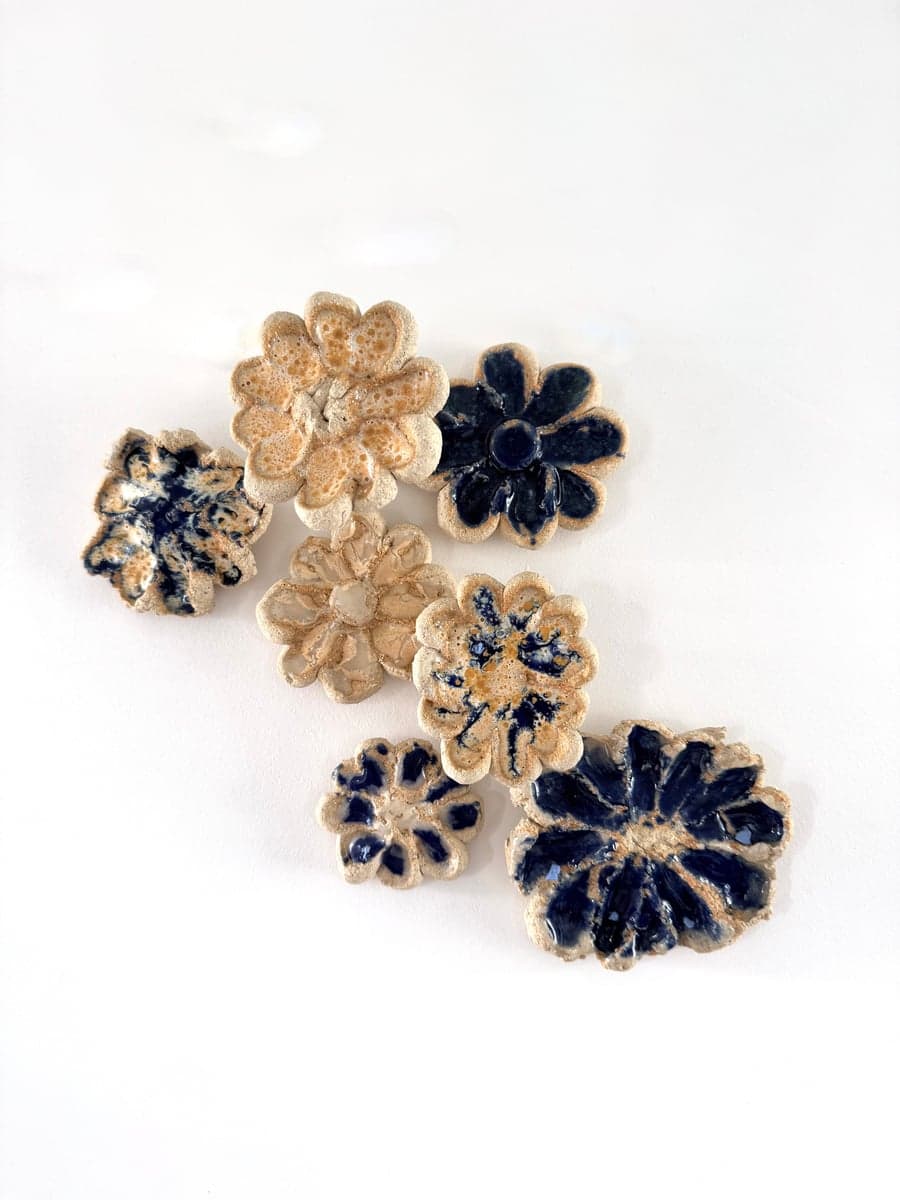
CLSTR is a series of collectible ceramic fragments called GSTRs. Each one is hand-built, unique, and designed to be displayed individually or in groups. A fragment measures roughly 5 to 10 cm, is glazed and high-fired, and is individually documented in the archive.
What are Patches and Fields?+
A small group of GSTRs installed together is called a Patch. Patches are typically created in private interiors and function as intimate clusters or accents. When the installation expands to architectural scale — hundreds or thousands of elements shaping an entire surface or space — it is referred to as a Field. Patches and Fields are not different objects, but different densities of the same work.
Can CLSTR be installed at architectural scale?+
Yes. Fragments can form small wall compositions or large-scale installations, depending on quantity and configuration. For larger projects (hospitality, public spaces, residential), please get in touch.
About the Object
Is each fragment unique?+
Yes. Each fragment is hand-built and numbered — shaped from a combination of gestures that never repeat the same way twice. No unit is moulded. Fragments can look alike, but each carries a unique number.
How big is one?+
Roughly 5 to 10 cm across, nearly square. Weight varies by piece — each fragment is weighed and the weight is recorded in the archive.
What clay is used?+
For now, only high-fired chamotte stoneware. The clay body may change in future batches, but today every fragment uses the same one.
Why are the surfaces not perfect?+
Because they are not industrial objects. Fingerprints, living edges, irregularities — these are the traces of the gesture that made the piece. CLSTR moves away from perfection; each mark is evidence of the hand.
Are they signed and numbered?+
Yes. Each fragment is signed and carries a unique number from 1 to 10,000. The packaging functions as the certificate of authenticity and contains the number and recorded weight.
The Concept
Why is CLSTR sold by weight?+
Because no fragment is worth more than another. Selling by weight refuses the hierarchy that size or appearance would impose — each piece carries its own gestures.
One artwork, many collectors?+
Exactly. CLSTR is a single artwork, fragmented into 10,000 pieces. Each collector owns a part of it — not the whole. The work lives across all of its walls.
What happens when all 10,000 fragments are made?+
Physically, the work stays dispersed forever. Once — online, at completion — every GSTR will be brought together into a single virtual composition, the only moment CLSTR will exist as one work.
Will the archive remain online?+
Yes. Each fragment is photographed, 3D-scanned, and documented. The archive is designed to remain online beyond the project's end, continuing to connect collectors and pieces.
Buying & Pricing
Can I buy just one?+
Yes. Many people begin with a single fragment and gradually add more to build a Patch over time.
How are they priced?+
GSTRs are sold by weight, not by size. The price per kilogram may evolve over the course of the project.
Where can I find the certificate of authenticity?+
The packaging functions as the certificate of authenticity. It includes the number and recorded weight of the fragment and stores flat — designed to be preserved as part of the CLSTR archive. If lost, a replacement certificate can be issued.
Where do you ship?+
We ship worldwide: via Mondial Relay within Europe, and via DHL everywhere else.
Delivery times: 2–5 business days in metropolitan France, 5–10 days for the rest of Europe, 3–8 business days for international DHL shipments.
Packaging: each fragment ships alongside its own certificate box. Packaging is optimised for shipping.
Customs duties: for shipments outside the European Union, import duties or taxes may be charged by local authorities upon delivery — these fees are not included in the price paid on the site.
Can I find fragments in person?+
Fragments are available at the following locations:
Atelier — Maurs
10 rue de la Martinelle, 15600 Maurs
L'empreinte de l'Autre — Naucelles
4 place Lardennes
La tikili — Maurs
15bis Tour de Ville, Maurs, France, 15600
www.facebook.com/people/La-Tikili/61584003672652/ ↗Les Art'scades — Saint-Flour
5 Place d'Armes, 15100 Saint-Flour
www.facebook.com/p/Les-Artscades-61576867580063/ ↗Moulin de Chaules — St.Constant
Lieu-dit Chaules - 15600 Saint Constant, France
moulin-de-chaules.com/ ↗Pricelist — Maurs
Valise — Naucelles
lapin — Londres
Installation
How do I install my GSTR?+
A single nail or screw in the wall. No special tools, no templates. Each fragment hangs from a single point.
Can I rearrange them later?+
Yes. The composition is never fixed — you can add, move, space out, or densify fragments at your own pace.
Are they fragile?+
High-fired stoneware is solid once on the wall. Handle with care during installation, as with any ceramic piece.
Have another question? Get in touch